Short Answer
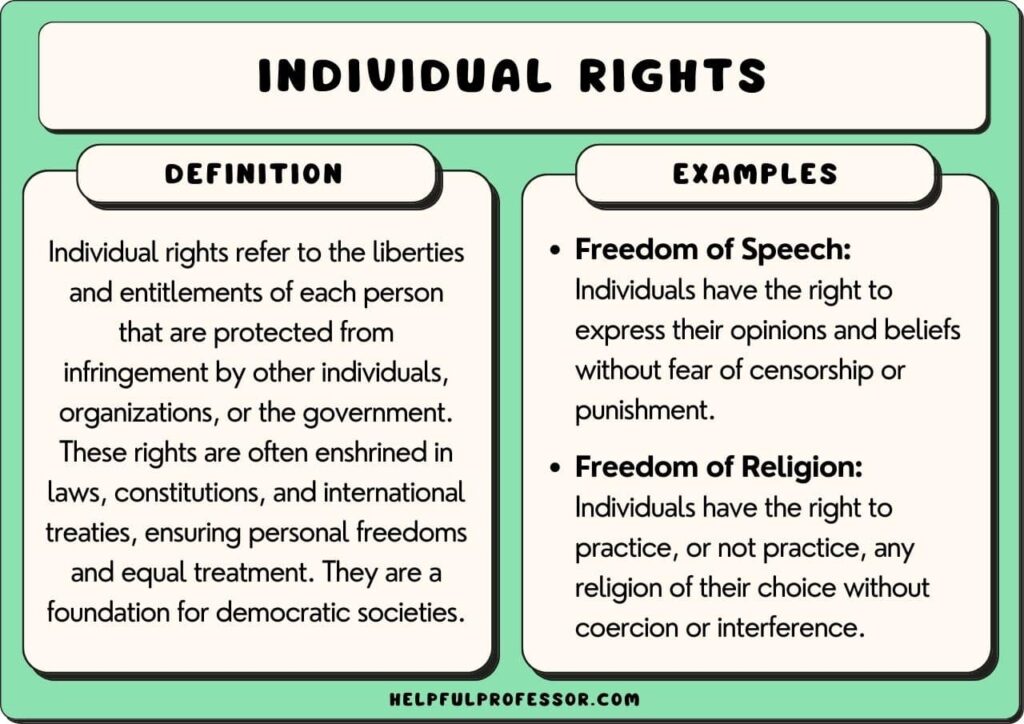
In an increasingly interconnected world, the concept of individual liberty stands as a cornerstone of democratic societies and social justice movements. But what, precisely, do we mean by ‘individual liberty’? It encompasses a myriad of rights that protect the freedoms of citizens against infringement by governments and other societal entities. Exploring real-world cases and legislative frameworks, we can better navigate this intricate landscape of rights. But, could the very freedoms we cherish also serve as a double-edged sword? Let us delve deeper into the manifold facets of individual liberty.
Individual liberty is often enshrined within legal frameworks that establish the extent of basic rights afforded to citizens. This includes the right to free speech, the right to privacy, the right to assemble, and the right to due process. Each of these rights can be illustrated by poignant examples. For instance, the right to free speech is not merely a theoretical concept but has been pivotal in numerous historical movements. A salient case that comes to mind is the historic civil rights movement in the United States during the 1960s. Activists such as Martin Luther King Jr. utilised their right to free speech to advocate for racial equality, demonstrating how such liberties can catalyse profound societal change.
However, consider the counter-argument: does unrestricted free speech provide a license for hate speech or misinformation? This dilemma raises pressing questions about where the line should be drawn in safeguarding both individual liberties and the social fabric.
The right to privacy forms another essential pillar of individual liberty. It protects citizens from unwarranted intrusion into their personal lives. The landmark case of ‘Carpenter v. United States’ (2018) underscores this right, where the U.S. Supreme Court ruled that accessing historical cell phone location data without a warrant was a violation of the Fourth Amendment. This case exemplifies the delicate balance between law enforcement interests and the right to personal privacy, illustrating how privacy rights have evolved with technology.
Yet, as technology advances, challenges abound. With widespread surveillance and data collection, one might question: does the convenience of digital life come at the cost of individual privacy? This ongoing tension invites further scrutiny regarding the adequacy of existing laws to safeguard rights amid the rapid pace of technological change.
The right to assemble freely is another significant aspect of individual liberty. This fundamental right was prominently encapsulated during the protests that erupted in various nations in the wake of social injustice and governmental neglect. For example, the ‘Black Lives Matter’ movement not only garnered international support but also illuminated the critical nature of the right to protest. In such instances, individuals come together to amplify their voices and advocate for change, thereby reinforcing the societal importance of collective action.
Nonetheless, the government’s response to such assemblies often poses challenges to this right. In many instances, authorities have employed measures to disperse or inhibit protests, citing public safety concerns. This begs a challenging question: at what point does the state’s responsibility to maintain public order encroach upon individual liberties? The potential for conflict between state authority and individual rights persists, inviting ongoing discourse and debate.
Another quintessential right to contemplate is the right to due process. This right ensures that individuals are afforded fair treatment within the judicial system. A pivotal example can be seen in the ‘Miranda v. Arizona’ case of 1966, where the Supreme Court ruled that detained individuals must be informed of their rights, laying down what we colloquially know as “Miranda rights.” This landmark decision has had lasting implications for how the justice system operates, reinforcing the idea that every individual is entitled to fundamental legal protections.
Yet, challenges remain within the judicial landscape. The complexities surrounding mass incarceration and socio-economic disparities raise crucial questions about the effectiveness of due process for all citizens. How can we ensure that every individual, irrespective of their background, receives equitable legal representation? The pursuit of justice remains a critical battleground for the assertion of individual liberties.
Additionally, the right to freedom from discrimination serves as a vital component of individual liberty, fostering an inclusive environment for all citizens. This principle has been enshrined in various laws across nations; the Equality Act in the United Kingdom, for example, protects individuals from discrimination based on characteristics such as race, gender, and sexual orientation. Cases that highlight this right often focus on workplace equality and access to public services. Yet, the reality of discrimination still pervades many aspects of life, leading individuals and groups to advocate vigorously for more robust protections.
This brings forth another critical query: are existing laws truly effective, or do they merely scratch the surface of a deeply entrenched societal issue? The need for ongoing advocacy and reform illustrates the constantly evolving nature of individual liberties.
Lastly, we must acknowledge the role of intersectional rights, which examine how various forms of discrimination overlap and affect individuals differently. The concept of intersectionality, coined by Kimberlé Crenshaw, emphasizes that understanding individual liberty demands a nuanced approach that recognises the diverse experiences shaped by race, gender, sexuality, and economic status. Prominent cases regarding intersectionality often highlight the plight of individuals who experience multiple layers of discrimination, urging lawmakers and society to adopt a more inclusive framework.
In conclusion, the exploration of individual liberties—illustrated through rights, laws, and real-world cases—reveals a complex and dynamic terrain. While such liberties are undeniably fundamental to a just society, they also present challenges that provoke thoughtful dialogue about the nature of freedom and the role of governmental authority. The interplay between personal rights and societal responsibilities continues to inspire debate, ensuring that individual liberty remains a vibrant and critical topic. As we reflect on these rights, we should continuously ask ourselves: how can we safeguard these freedoms while fostering a society that is equitable and just for all?
FAQ
What is individual liberty?
Individual liberty refers to the rights and freedoms that protect individuals from unwarranted interference by governments or others.
Which rights are considered part of individual liberty?
Rights such as free speech, privacy, assembly, due process, and freedom from discrimination.
Can individual liberty conflict with public safety?
Yes, balancing individual freedoms with public order is a common challenge, especially in cases involving protests or hate speech.
How do court cases influence individual liberty?
Courts interpret laws and set precedents that define the scope and limits of individual rights.
What is intersectionality's role in individual liberty?
Intersectionality helps understand how multiple forms of discrimination affect an individual's rights and freedoms.




Leave a Reply