
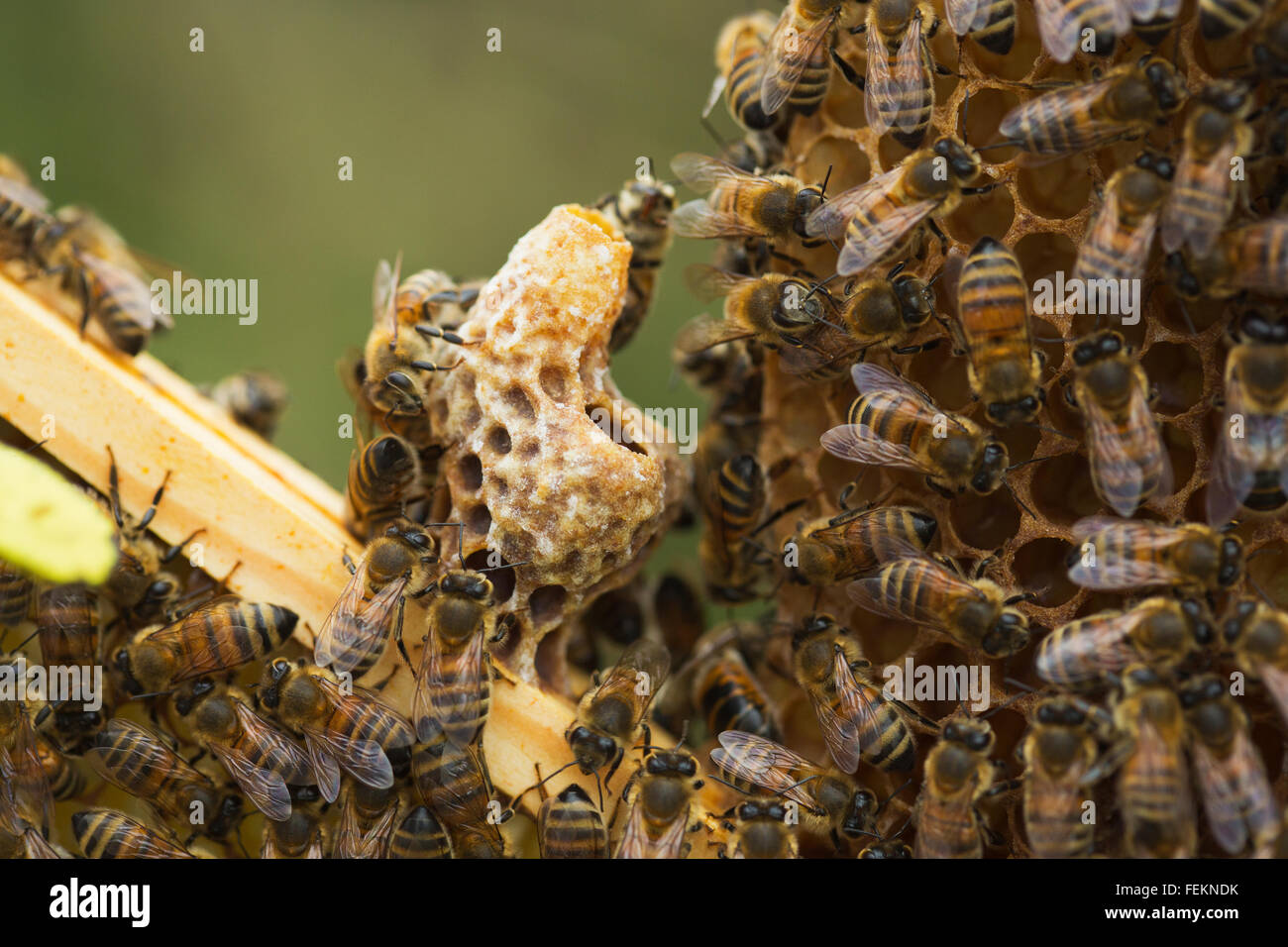
The honey bee. Ubiquitous pollinator. Social insect extraordinaire. Chances are you’ve encountered one buzzing around a garden flower or perhaps even had a less-than-pleasant interaction. But have you ever truly *looked* at a honey bee? Beyond the generalized “yellow and black” description, there lies a creature of intricate design and evolutionary marvel. Its appearance, far from arbitrary, is a testament to its crucial role in the ecosystem and the sophisticated social structure of the hive. Let’s delve into the detailed morphology of Apis mellifera, unveiling the subtle yet significant features that define this vital insect.
A Segmented Symphony: The Honey Bee Body Plan
Like all insects, the honey bee exhibits a body plan neatly divided into three distinct tagmata: the head, the thorax, and the abdomen. Each section is specifically adapted to perform unique functions essential for the bee’s survival and contribution to the colony.
The Cephalic Suite: Sensory Perception and Ingestion
The head, or cephalon, is a sensory powerhouse. It houses the honey bee’s primary sensory organs. A prominent feature is the pair of large, multifaceted compound eyes. These structures, composed of thousands of individual ommatidia, provide a mosaic-like view of the surrounding environment. This allows bees to detect movement with exceptional speed and perceive polarized light, a navigational aid particularly useful on sunny days. Three smaller ocelli, or simple eyes, are situated on the top of the head. These are believed to detect light intensity, helping the bee maintain orientation.
Antennae, segmented and highly mobile, are the bee’s primary olfactory organs. They are capable of detecting an array of scents, from floral nectar to pheromones released by other bees in the colony. These olfactory cues play a critical role in foraging, communication, and social organization.
The mouthparts of a honey bee are a complex adaptation for feeding. The mandibles, or jaws, are used for grasping, manipulating wax, and defending the hive. The proboscis, a long, hairy tongue-like structure, is designed for lapping up nectar and honey. It folds neatly beneath the head when not in use.
The Thoracic Engine: Locomotion and Flight
The thorax is the engine room of the honey bee, dedicated primarily to locomotion. It is divided into three segments, each bearing a pair of legs. The forelegs are equipped with specialized structures, including an antenna cleaner, which the bee uses to groom its antennae. The midlegs also have spurs used for cleaning wax scales from the abdomen. The hind legs are perhaps the most distinctive. They are equipped with pollen baskets, also known as corbiculae, which are concave, hair-fringed depressions used to transport pollen back to the hive. This adaptation is critical to the bee’s role as a pollinator.
Two pairs of wings are attached to the thorax. The forewings are larger than the hindwings, and they are connected by a series of tiny hooks called hamuli. This coupling mechanism allows the wings to function as a single aerodynamic surface during flight. The rapid beating of these wings, up to 200 times per second, generates the lift and thrust necessary for flight.
The Abdominal Repository: Digestion, Respiration, and Defense
The abdomen houses the honey bee’s digestive, respiratory, and reproductive systems. It consists of several overlapping segments. Wax glands, located on the ventral side of the abdomen, secrete wax scales that are used to construct honeycomb cells within the hive. The honey sac, a specialized pouch within the abdomen, is used to transport nectar from flowers back to the hive. This nectar is then converted into honey through a process of regurgitation and evaporation.
Spiracles, small openings located along the sides of the abdomen, are the external openings of the bee’s respiratory system. Air enters the body through these spiracles and travels through a network of trachea that deliver oxygen directly to the tissues.
A vital, and often feared, feature of the worker honey bee is the stinger, a modified ovipositor (egg-laying organ) located at the tip of the abdomen. It is barbed, meaning that once it is embedded in the skin of a mammal, it cannot be retracted. When the bee attempts to fly away, the stinger is torn from its body, along with the venom sac and associated muscles. This results in the bee’s death. Queen bees, in contrast, have a smooth stinger that can be used multiple times, primarily for combat with rival queens.
Coloration and Cuticular Ornamentation: Aposematism and Camouflage
The characteristic yellow and black banding of the honey bee’s abdomen serves as a form of aposematism, or warning coloration. This pattern signals to potential predators that the bee is capable of inflicting a painful sting. However, the exact shade and pattern of these bands can vary depending on the subspecies of honey bee. Furthermore, the density and distribution of hairs, or setae, on the bee’s body can also influence its overall appearance, providing a degree of camouflage in certain environments.
The cuticle, the bee’s external exoskeleton, is not just a protective barrier. It is also adorned with various structural features, including ridges, pits, and scales. These cuticular ornamentations can play a role in water repellency, thermal regulation, and even sound production.
Beyond the Basics: Variations Within the Colony
It’s important to note that the appearance of a honey bee can vary depending on its role within the colony. Worker bees, the sterile females that perform the vast majority of tasks within the hive, are typically smaller than the queen and drones (male bees). The queen bee, the sole reproductive female in the colony, is significantly larger and has a longer abdomen. Drones, whose primary function is to mate with the queen, are characterized by their large eyes and stout bodies.
The honey bee’s appearance is a microcosm of its intricate biology and ecological significance. Every detail, from the multifaceted eyes to the pollen-laden legs, reflects its adaptation to a specific lifestyle and its critical role as a pollinator. By taking a closer look at this seemingly simple insect, we gain a deeper appreciation for the complexity and beauty of the natural world.






Leave a Comment