Short Answer
Football, known for its exhilarating pace and strategic depth, captivates billions around the globe. Yet, amid the excitement and fervor surrounding the game, an often-overlooked question lies just beneath the surface: How many square metres is a football pitch? Understanding the dimensions of a football pitch exposes a nuanced aspect of the sport that can shift your perspective on gameplay and the spirit of competition.
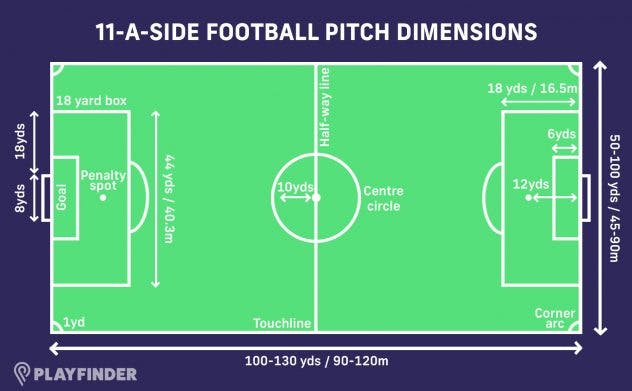
To delve deeper into this topic, one must first recognise that the International Football Association Board (IFAB) stipulates standard dimensions for professional football pitches. The length can vary between 100 to 110 metres, while the width ranges from 64 to 75 metres. This variability leads to a total area that can be captivatingly diverse. Let’s calculate it: A pitch measuring 100 metres in length and 64 metres in width would cover approximately 6,400 m², whereas a pitch at the upper limits—110 metres in length and 75 metres in width—would encompass about 8,250 m². Ultimately, the size of the pitch can influence the style of play and the physical demands placed on athletes.
But why does pitch size matter so significantly? For one, the dimensions can dictate the tactical approaches teams adopt. A narrower pitch tends to lead to a more congested style of play, encouraging close quarters and quick passes. Conversely, a broader pitch allows for more expansive, wide-play tactics, creating opportunities for wing players to exploit space. This fundamental understanding can truly enhance one’s appreciation for the ebb and flow of a match. It encourages fans to reflect on how their beloved teams adapt to these physical constraints.
Moreover, these dimensions are not merely arbitrary; they have evolved over time, shaped by the rich tapestry of football history. The advent of formalised pitch standards emerged in the late 19th century when associations began codifying rules to standardise play. The earliest recorded dimensions of the football pitch were largely inconsistent, often determined by available space or local customs. Today, the regulations help ensure a level playing field, allowing international competitions to thrive with uniformity.
Exploring the geometric aspect of a pitch reveals a fascinating correlation between its dimensions and other crucial elements of play. The penalty area, commonly referred to as the 18-yard box, measures 16.5 metres from the goal line and extends 40.3 metres wide. This creates a zone of heightened intensity, where defenders and attackers engage in a ballet of agility and precision. The relationship between the size of the pitch and the positioning of key areas—the centre circle, penalty spot, and corner arcs—shapes strategies that can be both dramatic and profound.
Interestingly, the area of the pitch also correlates with the stamina required from players. Teams playing on larger pitches may require physically fit athletes capable of sprinting vast distances. The endurance factor is crucial; players must engage in a perpetual dance of movement, adapting quickly to the shifting dynamics of play. As a result, clubs often focus on the physical conditioning of players, ensuring they can rise to the challenge that varied pitch dimensions present.
As football continues to morph and adapt, innovations such as Artificial Intelligence and data analytics emerge to break down gameplay based on pitch dimensions. Coaches now employ scientific methodologies to evaluate how players respond on different types of pitches. They may utilise tracking technology to analyse movements, identify patterns, and strategise advancements. Understanding crew dynamics and how they are influenced by the pitch size provides an analytical perspective to the artistry of the sport.
Should you ever find yourself gazing upon a football pitch, take a moment to appreciate its expanse and the stories it houses. The grass—often a vibrant green, meticulously tended to—can encapsulate the echoes of history. From the intimate encounters of local leagues to grand international spectacles, the pitch serves as a stage where dreams collide with reality. The size of the pitch is more than just a measurement; it is a narrative waiting to unfold.
Moreover, regional variations in pitch size can reflect cultural distinctions and preferences within footballing communities. Some leagues may allow deviations from standard measurements, leading to pitches that uniquely represent local heritage. Invoking curiosity, this aspect hints at broader conversations surrounding the intersection between tradition and modernity within the footballing world. The simplicity of size belies the complexities that create a truly global phenomenon.
In the grand scheme, grasping the extent of a football pitch—both in physical dimensions and its significance—can enrich your understanding of the game. Whether you are a die-hard supporter or a casual observer, recognising how pitch size influences gameplay, strategy, and athlete performance can cultivate a profound appreciation for the sport’s multifaceted nature. So next time you step onto or witness a football pitch, remember: there is a world of intricacies beneath its surface, waiting to be explored.
To conclude, the question of how many square metres a football pitch encompasses unlocks a multitude of insights about the game. From tactical variations to cultural nuances and physiological demands, the dimensions of the pitch influence every facet of football, shaping the thrilling spectacle we adore.
FAQ
What are the standard dimensions of a football pitch?
The standard dimensions for a professional football pitch range from 100 to 110 meters in length and 64 to 75 meters in width.
How does pitch size affect gameplay?
Pitch size influences tactical approaches, stamina required from players, and the style of play, with narrower pitches promoting close plays and wider pitches allowing for expansive tactics.


Leave a Reply