
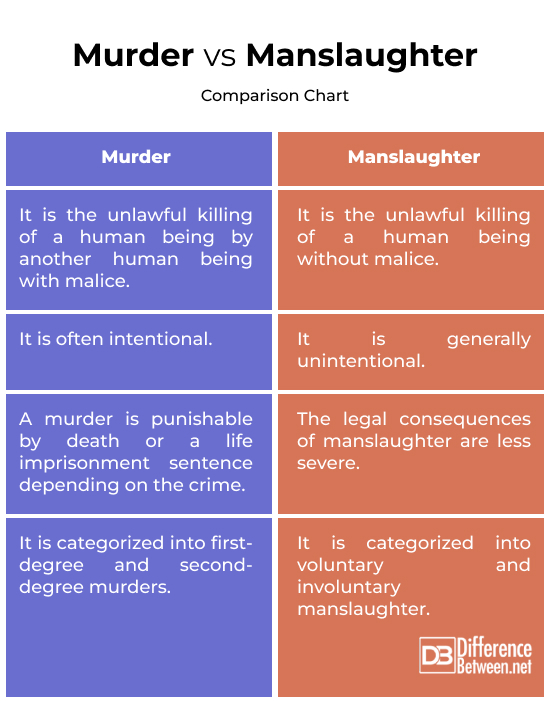
In the realm of criminal law, the distinction between manslaughter and murder is one that evokes considerable debate and confusion. Both terms pertain to the unlawful taking of human life, yet they carry significantly different legal implications, moral connotations, and psychological underpinnings. This article aims to elucidate the intricate nuances that separate murder from manslaughter, delving into legal definitions, categories, and the societal fascination with these grave offences.
At its core, the principal differentiation between murder and manslaughter lies in the element of intent. Intent plays a pivotal role in how these crimes are classified under the law. Murder is generally defined as the intentional unlawful killing of another person with malice aforethought. This term “malice aforethought” encapsulates not merely a desire to kill but also encompasses a broader category of intents—such as a callous disregard for human life. In many jurisdictions, murder may be further divided into categories such as first-degree and second-degree murder, each carrying its own set of criteria and penalties.
First-degree murder typically involves a premeditated act, reflecting a deliberate plan to commit the crime. This means that the perpetrator considered the action, possibly even engaging in elaborate schemes to carry out the murder. In contrast, second-degree murder is often defined as an unplanned killing that arises from reckless or dangerous conduct showing a disregard for life. For instance, if an individual engages in a violent altercation that unintentionally results in death, this may be classified as second-degree murder due to the reckless indifference demonstrated.
Manslaughter, conversely, is characterized by the absence of malice aforethought. This classification acknowledges situations where a killing occurs but lacks premeditation and intent to kill. Legally, manslaughter can be subdivided into voluntary and involuntary categories, each marked by specific circumstances and emotional states. Voluntary manslaughter occurs when an individual kills in the heat of passion or under extreme emotional disturbance. A classic example would be a spouse who discovers their partner in an adulterous situation. The sudden surge of emotion may lead to an impulsive act of violence, distinct from cold calculation.
Involuntary manslaughter, on the other hand, encompasses unintentional killings that result from negligent actions. This could involve scenarios where an individual’s careless behaviour inadvertently leads to another’s death—such as a person failing to secure a weapon that subsequently discharges and kills someone nearby. Here, the absence of intent is notable; the perpetrator did not seek to harm anyone, yet they are held accountable for the tragic outcome of their negligence.
Understanding the nuances of intent also extends into the realm of legal defences. In murder cases, defendants may attempt to establish that they acted in self-defence or under duress to mitigate the charges against them. A successful argument can transform a murder charge into a manslaughter charge, as it negates the requisite malice aforethought, thereby shifting the legal framework within which the incident is judged.
This distinction begs a broader inquiry into societal attitudes toward these crimes. The words “murder” and “manslaughter” elicit strong reactions, evoking notions of morality, justice, and the sanctity of life. The fascination surrounding these terms is often rooted in the complexity of human emotions and the myriad of circumstances that can influence a person’s decision to take another life. It prompts deep philosophical questions about accountability, justice, and the law’s ability to truly encapsulate human morality.
Furthermore, the media often plays a significant role in shaping public perception of these terms. High-profile cases of both murder and manslaughter frequently dominate the news cycle, inviting intense scrutiny and discussion. When a case is labelled as murder, it often engenders outrage and demands for justice that may not be as pronounced in manslaughter cases, which, while equally tragic, may invoke a sense of compassion for the human failings involved. This disparity in emotion underscores the societal tendency to view murder as an unforgivable transgression, whilst manslaughter can sometimes be perceived through the lens of empathy.
In practical terms, the legal consequences of these charges also differ markedly. Murder is often punishable by extensive prison sentences or even life in prison, depending on jurisdictional laws. In some areas, capital punishment may be a potential penalty for the most heinous of murders. In contrast, sentences for manslaughter can vary widely, often resulting in lesser prison terms or even probation, particularly in cases classified as involuntary manslaughter. This disparity in punishment highlights the law’s nuanced approach to culpability—acknowledging not merely the act itself but the intent and awareness behind the actions.
The legal definitions of murder and manslaughter also highlight the importance of societal values in shaping the laws surrounding these acts. The evolution of these definitions reflects changing attitudes toward violence, accountability, and the moral considerations inherent in human behaviour. As society grapples with its understanding of justice, the categorisation of these acts continues to evolve, reflecting both legal precedents and cultural shifts.
To conclude, whilst murder and manslaughter may seem similar at first glance, they are profoundly different at their core. The distinctions hinge primarily on the intricacies of intent and the surrounding circumstances that lead to the taking of a life. Both terms encapsulate deep societal concerns regarding morality, justice, and the complex tapestry of human emotions. Understanding these differences not only clarifies legal definitions but also engenders a greater appreciation of the profound implications these actions hold within the tapestry of human experience.






Leave a Comment