
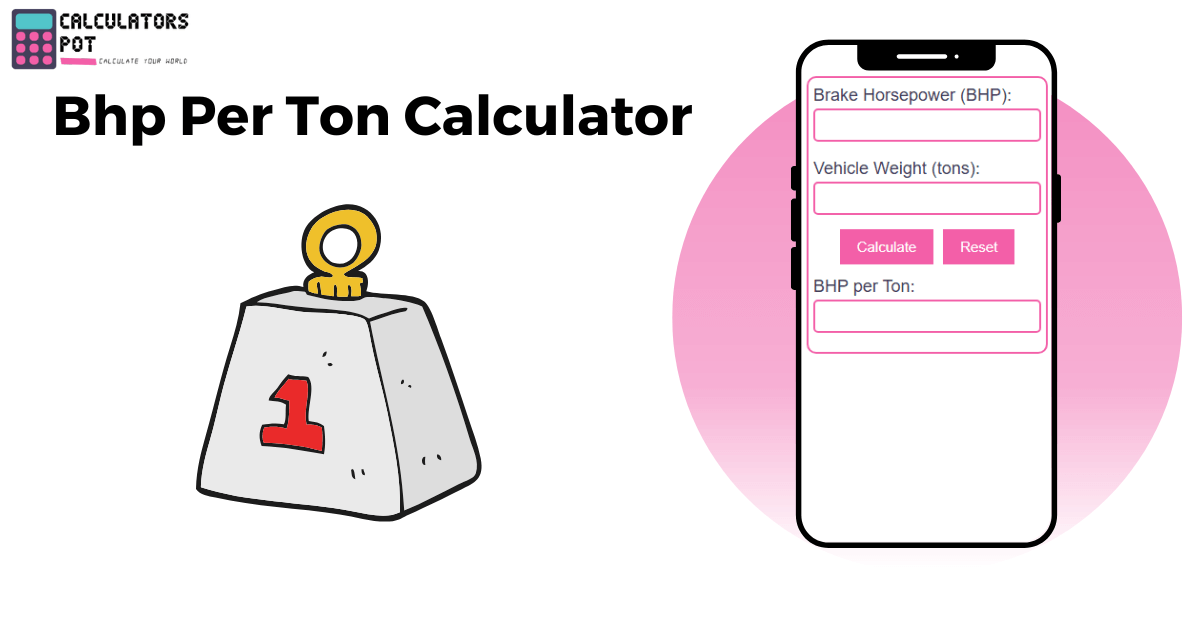
When it comes to evaluating the performance of a vehicle, one of the critical metrics that enthusiasts, engineers, and buyers often consider is the power-to-weight ratio, commonly designated as BHP per ton. This measurement provides invaluable insights into how effectively a vehicle can translate its engine power into acceleration, speed, and overall performance. Understanding how to calculate this ratio can not only aid in making informed decisions when purchasing a car, but it can also reveal deeper truths about automotive dynamics, efficiency, and even the engineering ethos behind various models.
To embark on this journey towards understanding the BHP per ton calculator, we must first elucidate what exactly encompasses the terms ‘BHP’ and ‘ton’. BHP, or Brake Horsepower, serves as an industry-standard metric for measuring the power output of an engine before losses like friction occur in the gearbox, alternator, differential, and other ancillary components. Essentially, BHP provides a raw figure that reflects a vehicle’s capability. On the other hand, weight is typically measured in tons; for the automotive world, a ton corresponds to approximately 1000 kilograms or 2204.62 pounds. The ratio of these two elements—power and weight—ultimately determines how much potential energy is available to move the vehicle.
Now, let’s dive into the actual calculation. To compute the BHP per ton, one must divide the engine’s brake horsepower by the vehicle’s weight in tons. The formula can be neatly summarised as:
BHP per ton = BHP / Weight (in tons)
For instance, if a car boasts a BHP of 200 and weighs 1.5 tons, the calculation would yield:
BHP per ton = 200 / 1.5 = 133.33
This means the vehicle has a power-to-weight ratio of approximately 133.33 BHP per ton, providing a quantifiable insight into its performance capabilities. A higher ratio typically indicates a faster, more responsive vehicle. Conversely, a lower ratio might suggest heavier, less agile performance.
One cannot overlook the implications of various BHP per ton figures. For instance, sports cars often flaunt ratios above 250 BHP per ton, which translates to blistering acceleration and impressive agility. In contrast, family sedans may hover around the 100 to 150 BHP per ton range, ensuring sufficient power for everyday driving without sacrificing comfort or safety. The difference in BHP per ton significantly impacts not only the driving experience but also the vehicle’s ability to navigate diverse terrains and conditions.
The fascination surrounding the power-to-weight ratio is not merely confined to raw numbers; it also encapsulates an entire philosophy of automotive engineering. When designers conceptualise a vehicle, they meticulously balance power, weight, and aerodynamics to achieve optimal performance. This trifecta is at the heart of competitive racing, where milliseconds can determine victory or defeat. The physics of motion reveals a captivating dynamic, as lighter vehicles equipped with robust engines have the potential to outperform their heavier counterparts significantly.
Furthermore, the development of technology has continually influenced the BHP per ton landscape. Advances in materials science have allowed for the production of lighter and stronger components, facilitating more advantageous power-to-weight ratios. Carbon fibre, aluminium alloys, and advanced composite materials are implemented in the design of high-performance vehicles, enhancing their agility without compromising structural integrity. This progressive trajectory is not only a testament to human ingenuity but also showcases a commitment to sustainability through fuel efficiency—an increasingly pivotal concern in modern automotive design.
The calculation of BHP per ton does not take place in isolation. External factors, such as aerodynamics and traction, interplay significantly with the power-to-weight ratio. A power-packed engine may struggle if the vehicle’s design is not aerodynamic enough to minimise drag, whilst a finely-tuned chassis may require attention to weight distribution to ensure optimal traction. Hence, understanding the BHP per ton metric empowers enthusiasts to consider the broader vehicle dynamics that contribute to performance.
Moreover, this measure is useful beyond mere speed; it extends to the realms of safety, control, and driver experience. A vehicle with a higher power-to-weight ratio often possesses more responsive handling characteristics, allowing for enhanced control during manoeuvres. This is particularly vital in scenarios demanding sudden acceleration or sharp turns, where a robust power-to-weight ratio can spell the difference between a seamless drive and a precarious situation.
Ultimately, the BHP per ton calculator serves as a gateway to appreciating the intricacies of automotive engineering and performance. Beyond the formulaic representation of power and weight lies a rich tapestry of design philosophy, technological innovation, and the quest for excellence. Enthusiasts and casual drivers alike are drawn to the visceral experience of driving high-performance vehicles, igniting a passion that continues to fuel advancements in the automotive industry.
As one delves deeper into the world of automotive performance metrics, it becomes evident that the BHP per ton measurement is more than a numerical value; it is a reflection of aspirations, dreams, and the human desire to push the boundaries of possibility. Ultimately, it encapsulates an ongoing dialogue between man and machine, constituting a fascinating exploration of what drives us, quite literally, forward.







Leave a Comment